
The house of the BJP Minority Morcha's Manipur president, Asker Ali, was set on fire by a mob allegedly for supporting the Waqf Amendment Act. The incident happened at Lilong in Thoubal district on Sunday night. Ali had expressed his support for the Act on social media on Saturday. An irate mob gathered outside his residence around 9 pm, vandalised it and later set it on fire. Following the incident, Ali posted a video on social media, apologising for his earlier statement. He also expressed opposition to the Act.

With Jay Shah taking over as International Cricket Council's youngest chairman on December 1, the role of secretary in the mighty BCCI lies vacant and as officials wonder who the replacement might be, they have time to figure out the next course of action.

Congress MP Mohammad Jawed and AIMIM president Asaduddin Owaisi have challenged the validity of the Waqf (Amendment) Bill, 2025 in the Supreme Court, arguing that it violates constitutional provisions. The petitions claim the bill imposes arbitrary restrictions on Waqf properties and their management, undermining the religious autonomy of the Muslim community. They also allege that the bill discriminates against Muslims by imposing restrictions not present in the governance of other religious endowments. The bill was passed in the Rajya Sabha and Lok Sabha, with the petitioners arguing that it introduces limitations on the creation of Waqfs based on the duration of one's religious practice, mandates inclusion of non-Muslim members in Waqf administrative bodies, and shifts key administrative functions to government officials, thereby diluting the autonomy of Waqf management.
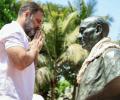
Congress leader Rahul Gandhi on Wednesday criticized the Waqf (Amendment) Act, calling it anti-constitutional and an attack on freedom of religion. He warned that the BJP-RSS will soon target the rights of other minorities, such as Christians and Sikhs. Gandhi also accused Prime Minister Narendra Modi of succumbing to pressure from US President Donald Trump on the imposition of tariffs, citing a recent meeting between the two leaders. He also questioned PM Modi's recent meeting with Bangladeshi leader Mohammad Yunus, who has been critical of India's policies. Gandhi further advocated for a caste census in India, stating that Congress aims to break the barrier of 50% reservation.

There is an acute imbalance of power between the various organs of the State, including the executive, the legislature, the judiciary, and the ultimate sovereign -- the people, argues R Jagannathan.

Fourth-term Bharatiya Janata Party MP Nishikant Dubey, one of the more vocal party members in the Lok Sabha, launched a broadside against the Supreme Court on Saturday, saying Parliament and state assemblies should be closed down if the apex court has to make the laws.
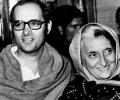
During Emergency Indira Gandhi acquired absolute power. Lakhs of political opponents, students, activists were arrested.

The Supreme Court of India has censured BJP MP Nishikant Dubey for his remarks against the judiciary, stating that his comments "tend to scandalize and lower the authority of the Supreme Court of India." The court dismissed a contempt petition against Dubey but issued a scathing order criticizing his remarks, which included accusations that the court was "taking the country towards anarchy" and that Chief Justice Sanjiv Khanna was "responsible for the civil wars taking place in the country." The court deemed Dubey's statements "highly irresponsible" and indicative of an attempt to "incite religious wars." The order highlighted the importance of maintaining public confidence in the judiciary and condemned attempts to undermine its authority.
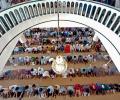
The All India Muslim Personal Law Board (AIMPLB) has urged Muslims to wear a black armband on their right hand during Juma prayers on the last Friday of Ramzan as a mark of protest against the Waqf (Amendment) Bill. The AIMPLB has been vocal in its opposition to the Bill, calling it "controversial, discriminatory and damaging." The organization has planned nationwide protests against the Bill, with large sit-ins scheduled in several cities.

The proposed Lokpal will have the status of a Constitutional authority for which purpose the Constitution will be amended, Union Law Minister Salman Khurshid disclosed on Tuesday night.

The Madhes-based parties have been protesting for over four months against the seven-province model proposed in the new Constitution that divides their ancestral land.
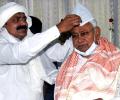
'Muslims in Bihar under Nitishji's rule are safest than anywhere else.'
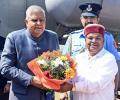
Karnataka Governor Thaawarchand Gehlot has reserved the Bill pertaining to four percent reservation for Muslims in government contracts for the President's assent, citing constitutional concerns. The Bill, which has been a subject of controversy in Karnataka, was passed by both houses of the state legislature amid protests from the opposition BJP. The Governor's decision to reserve the Bill highlights the ongoing debate over the constitutionality of religious-based reservations in India.
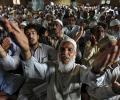
The All India Muslim Personal Law Board (AIMPLB) has announced its intention to challenge the Waqf (Amendment) Bill in court, labeling it a "black law" that threatens the community's rights. The AIMPLB, a major organization representing Muslims in India, asserts that the Bill, if passed, would lead to the seizure of Muslim properties and undermine the autonomy of Waqf Boards. The organization plans to launch nationwide protests against the Bill, echoing the farmers' agitation, and has urged all citizens to resist the legislation. The Bill has been met with criticism from various quarters, including opposition parties, who claim that the Centre is rushing it through Parliament without adequately addressing concerns raised by the Joint Parliamentary Committee (JPC).

Tamil Nadu Governor R N Ravi should free himself from divisive forces and discharge duties as per Constitutional norms, if he intends to continue as governor, Chief Minister M K Stalin said, and asked him to desist from converting Raj Bhavan into a political party office to depict Dravidian race in poor light.

The joint committee of Parliament examining the Waqf (Amendment) Bill submitted its report to Lok Sabha Speaker Om Birla on Thursday. The panel adopted the report by a majority vote, with changes suggested by members of the ruling BJP. Opposition members, who submitted dissent notes, called the exercise an attempt to destroy Waqf boards and termed the bill an attack on the constitutional rights of the Muslim community.

The situation in these violence-hit places remained tense on Saturday morning, but no untoward incident was reported, officials said.

Opposition parties on Wednesday opposed the 'one nation, one election' proposal by calling it impractical and a 'cheap stunt' by the ruling Bharatiya Janata Party.

Saying the law doesn't recognise the concept of marital rape, the Delhi high court has quashed an order directing prosecution of a man for performing 'unnatural' sex with his wife.

The top court took note of the submissions of senior advocate Abhishek Singhvi, appearing for the Delhi government, that earlier the challenge was directed against the Ordinance which has now become law after clearance from Parliament.

The International Olympic Committee issued the roadmap for India's return to the Olympic fold under which the Indian Olympic Association will have to amend its constitution before July 15 and elect new office bearers by September 1, both under the watchful eyes of the world body.

Caste census politics took centre stage on Thursday with the Congress terming the government's decision as a 'diversionary tactic' and a move for headlines management and the Bharatiya Janata Party saying it has exposed the difference between the Centre's 'true intentions' and the 'empty sloganeering' of the opposition party.

The Supreme Court of India has agreed to hear on May 6 the pleas of the Kerala government against the governor over the delay in approving bills passed by the state assembly. The court will consider whether the issues raised in the Kerala petition are covered by a recent judgment on a similar plea by Tamil Nadu, which set timelines for governors and the President on granting assent to bills.

'Trump has signaled that he has changed his stance on the H1B visa from his first term.'
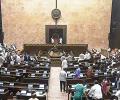
The Rajya Sabha, India's upper house of parliament, witnessed its second-longest sitting in history on Thursday, lasting until 4:02 am the next day. The House convened to clear the Waqf (Amendment) Bill and approve the statutory resolution on the imposition of President's Rule in Manipur. The longest sitting in Rajya Sabha history occurred on September 17, 1981, when the House sat until 4:43 am to pass the Essential Services Maintenance Bill.
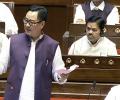
'It is not as if Hindus are not being touched at all, and only Muslims are.'

A bench comprising Chief Justice D Y Chandrachud and justices P S Narasimha and Manoj Misra said the detailed order referring the case to a larger bench will be uploaded on the apex court website later in the day.

In a reprieve to the suspended Indian Olympic Association, the International Olympic Committee has decided to extend the deadline for adopting an amended constitution, the draft of which is currently being reviewed by the world body.

Adding petrol and diesel to GST was a challenging task due to their significant role as revenue generators for both the central and state governments.

Attorney General K K Venugopal told a bench headed by Justice Bobde that the Constitution (103 amendment) Act, 2019 granting 10 per cent reservation to EWS is intended to uplift around 200 million people who are still below the poverty line.
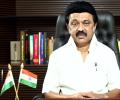
Tamil Nadu Chief Minister and DMK president M K Stalin announced that his party will file a case in the Supreme Court against the Waqf Bill passed in the Lok Sabha. The opposition AIADMK expressed solidarity with the DMK's stance, while the BJP members staged a walkout from the Assembly in protest. The CM argued that the amendment was passed at the behest of a few allies despite opposition from majority parties and that it is an attack on the Constitution and religious harmony. The DMK claims the bill threatens the autonomy of the Waqf Board and the Muslim minority population.
A landmark constitutional reforms package aimed at striking down the Pakistani president's sweeping powers and strengthening democratic institutions was tabled in Pakistan's parliament on Friday, with the ruling Pakistan People's Party describing it as a "bill of hope".
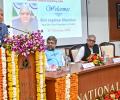
Vice President Jagdeep Dhankhar has questioned the Chief Justice of India's involvement in executive appointments, specifically citing the selection of the CBI director. He believes this practice undermines democratic principles and calls for revisiting the existing norms. Dhankhar also raised concerns about the "doctrine of basic structure", suggesting it has a debatable jurisprudential basis. He emphasized the importance of each institution operating within its constitutional boundaries and highlighted the need for coordinated autonomy. The vice president also discussed the need for a balanced approach to judicial review and the importance of judges focusing on judgments rather than other forms of expression. He stressed the need to revisit the current state of affairs to restore the judiciary's sublimity.

If nominees pass away, distribution is governed by succession laws of insured's religion.

The Supreme Court of India began hearing a batch of petitions challenging the constitutional validity of the Waqf (Amendment) Act, 2025. The bench, led by Chief Justice Sanjiv Khanna, asked both sides to address whether the court should entertain the petitions or relegate them to the high court. The hearing is underway with senior advocate Kapil Sibal arguing for the petitioners. The act, which was passed by Parliament following heated debates, has been challenged by various parties including AIMIM leader Asaduddin Owaisi, All India Muslim Personal Law Board (AIMPLB), and Jamiat Ulama-i-Hind.
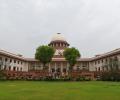
A Governor does not possess any discretion in exercise of functions under Article 200 of the Constitution in respect to any bill presented to them and must mandatorily abide by the advice tendered by the council of ministers, the Supreme Court has held.

Experts say the state's economy is grappling with hidden debt, rising welfare costs, and lack of transparency.

The Supreme Court of India has ruled that maternity leave is a fundamental right and cannot be denied to a woman based on the number of children she has from previous relationships. The court overturned a Madras High Court decision that had denied maternity leave to a Tamil Nadu government school teacher who had two children from a previous marriage. The Supreme Court emphasized the importance of reproductive rights, including maternity benefits, as part of international human rights law. The court also highlighted the right to life under Article 21 of the Indian Constitution, which includes the right to health, dignity, and reproductive choice. The decision has significant implications for women's rights and reproductive healthcare in India.

Errors in filing income-tax returns frequently lead to scrutiny notices, additional liabilities, or delayed refunds.
Is there no mechanism to abrogate Article 370 even when the people of Jammu and Kashmir want it, the Supreme Court asked on Thursday and wondered if the now repealed provision can't be touched, will it not amount to creating a "new category" beyond the basic structure of the Constitution.
